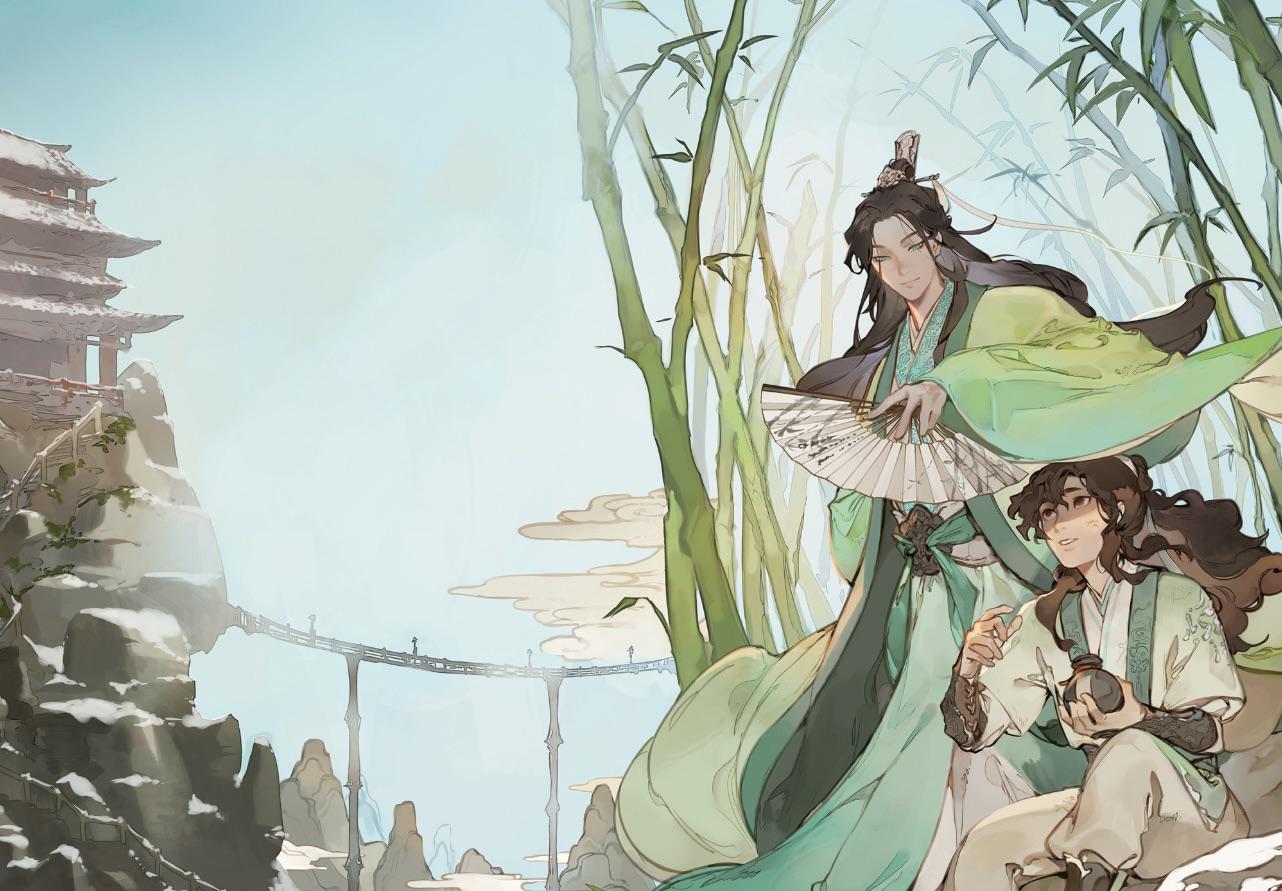
Scum Villain’s Self-Saving System (SVSSS) was MXTX’s first work published to Jinjiang Literature City. It ran from September 21, 2014 until June 23, 2015. Boasting 95 chapters and 432,198 characters its print adaptation spans 4 books. Despite being her least popular series (only having 17.3 billion points, a fourth of Heaven Offical’s Blessing) it was by no means a commercial failure. In fact, MXTX served jail time for violating online profit laws in China1, essentially suffering from success. Some, however speculate this may have been an excuse, as the actual content of her work, gay and pornographic content, were entirely plausible causes for her arrest2 .
Our questions regarding SVSSS is why has it failed to reach the levels of commercial success that her other works have? How has it been disseminated into popular culture in the West and China? What does this say about the production of digital labor and fan communities? What does it say about the body of MXTX work as a whole?
Plot
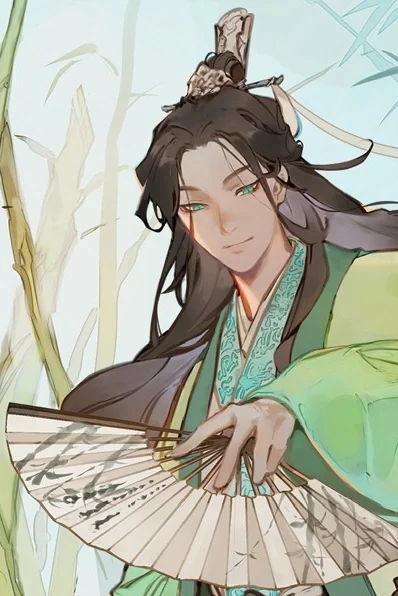
Shen Yuan, avid hater (fan) of the never ending stallion novel, Proud Immortal Demon Way(PIDW), dies and is transmigrated into his most hated (loved) story. Now inhabiting the body of PIDW’s most reviled Scumbag-Villain, Shen Qingqiu, he has to find a way to thwart the original’s horrible end as a human stick… by accidentally becoming the main love-interest?

Characters
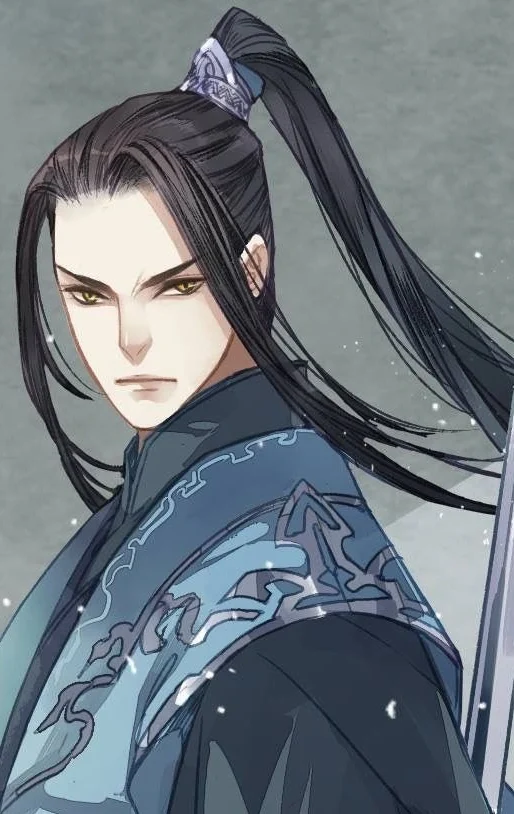
Shen Yuan (沈垣)(Shen Qingqiu (沈清秋)) Aka. Peerless Cucumber (絕世黃瓜)
- Must work with the system to change his fate and avoid becoming a human stick.
- Main Character, Transmigrated into the world of PIDW.
- Modern day fan, accidentally makes the main character, Luo Binghe, fall in love with him.
Shen Jiu (沈九)(also Shen Qingqiu (沈清秋)) aka. Original Goods
- Original Shen Qingqiu and a Peak Master of the Cang Qiong Mountain Sect.
- Killed by OG Binghe in revenge for being a scumbag – villain.
- Deeply unpleasant and disliked man – but perhaps has more depth than originally thought.
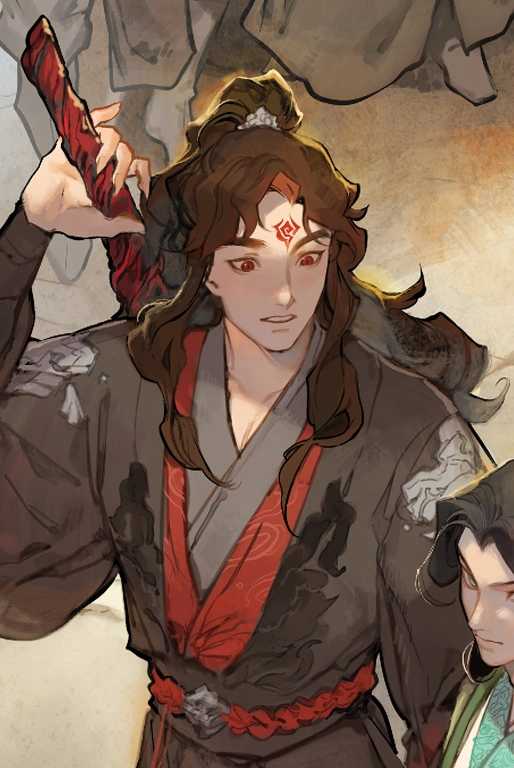
Luo Binghe (洛冰河)
- Half-demon Protagonist of PIDW, originally conquered the world and had a harem of over 600 women.
- Now he’s the the love interest of Shen Yuan and is obsessed with staying with his ‘Shizun’.
- Morally dubious and moderately mentally unstable.
Yue Qingyuan (岳清源)
- Leader of the Cang Qiong Mountain sect.
- Originally killed by Mobei-jun and 10,000 arrows.
- Shared past with Original Shen Qingqiu.
Liu Qingge (柳清歌)
- Peak Lord of Bai Zhan Mountain.
- Originally killed by O!SQQ, but was saved by Shen Jiu.
- Motivated by strength and battle.
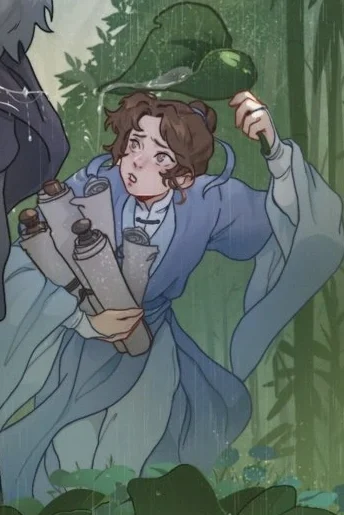
Shang Qinghua (尚清华)aka “Grand Master” Airplane shooting for the Sky (向天打飞机)
- Originally the author of PIDW, accidentally transmigrated into Shang Qinghua’s body as a baby.
- Helps out Shen Yuan, does not know as much about his novel or plot as one would think.

Scum Villain’s Self-Saving System, Genre, and Gendered Power
SVSSS is fundamentally a danmei (耽美) novel – written primarily for female audiences (Feng). As mentioned before, danmei “queer” (typically male-male) literature written largely for and by women. The relationships therein are reflections of women’s desires and views on the gendered dynamics of romantic relationships.
In SVSSS, Erotic Labor is changed into digital labor. Professor Ni cites how Scum Villain’s protagonist, Shen Qingqiu, begins the story as a Freudian Father figure, reviled and punished, before transforming into a nurturing Mother figure (Ni). Through Shen Qingqiu’s emotional journey, and romance with Luo Binghe, and more importantly the meta-textual acknowledgement of reader and author interaction, SVSSS acts as a subversion of typical male-power fantasy novels. It offers female escapism by reifying the desires of the female readership it is written for revealing.
The Original Proud Immortal Demon Way: Masculine Power Fantasy
Proud Immortal Demon Way is originally, as Shen Qingqiu defines it, a “garbage and a total power fantasy “stallion novel” (MXTX,SVSSS B1). Luo Binghe, the protagonist, is a dark romance leader. The embodiment of a revenge fantasy, Luo Binghe begins Proud Immortal Demon way as a lowly orphan, abused by those more powerful than him, especially by his cruel Shizun, Original Shen Qingqiu. Only after discovering his mysterious internal power and being expelled from his sect (cultivation school) that he becomes the most powerful cultivator, and eventually Emperor of multiple realms. Along the way he collects a harem of over 600 female characters, all of whom exist only to serve and emphasize his sexual prowess and power. Importantly, he tortures and executes Original Shen Qingqiu, committing pseudo-patricide and violently removing what could be deemed as a “sexual” threat to his power.
Scum Villain’s Self-Saving System: Feminine Idealism
In SVSSS, however Shen Qingqiu is able to circumvent the original’s fate by becoming the “female”. Instead of the threatening and sexually confusing father figure, he becomes motherly as he raises Luo Binghe and eventually falls in love with him.
It is a pointed conclusion, with the “story” even pointing out how the novel PIDW becomes a Danmei novel within SVSSS’s universe. By embracing the feminine elements of relationships and nurturing the the protagonist, Shen Qingqiu is able to improve all the outcomes of this world.
In this way, MXTX emphasizes feminine nurturing for its ability to improve a story and make it better – contrasting it with the hyper masculinity of a typical shallow Qidian “stallion novel”. This story line, then, emphasizes that true connection comes from female oriented works. Shen Qingqiu and Binghe’s romance embodies female readers’ desires and their frustration with traditional male centered narratives, as well as female readers and authors’ perspectives on male power fantasy novels. Most importantly, though, SVSSS demonstrates how female erotic labor is able to change and improve outcomes for readers.
Transmigration (穿越小说, lit. to cross into fiction) in SVSSS
Definition: Genre where the protagonist enters the world of another person, often from fiction or history.
Transmigration is a genre of web-fiction wherein the protagonist is transported into the body of another person or even a different themselves. This manifests in a plethora of ways. The protagonist might be dropped into the body of a historical figure, or a character from their favorite book or show.
In these stories, the protagonist usually uses their unique knowledge, from either the future, or from reading the source material to change the outcome of the original plot (Feng, Have Mouse 51). There is a strong element of escapism in these works, as they imagine a typical person being transported into a magical new life, escaping the humdrum of modern society. The status of the protagonist as a transmigrated character often means that an otherwise “normal” person has now become special, and is able to become accomplished in their new world, in other words they obtain a “golden finger” status (Feng, System 206).
Transmigration also easily allows readers to project onto the protagonist and mirrors the reader’s experience of reading. Not only are some transmigrated protagonists, such as Shen Qingqiu, literally web fiction readers, but their “normal” lives before being transported, tend to reflect the lives of readers. Therefore, many transmigrated protagonists have lived the life of an overworked office worker or student prior to their magical transportation, reflecting the readership of webnovels. Of course, there are exceptions to this rule, and authors will also transmigrate characters with specific skills, such as accomplished chefs or highly-trained soldiers, in order to contrast the achievements of the modern world with those of a different time or space.
in SVSSS
Shen Qingqiu is first and formost a web-fiction reader. He embodies the labor and work of many readers and fans, commenting, liking and sharing about PIDW. His comments on the story include – complaining about how “gross and sex oriented” PIDW is (MXTX, SVSSS B2) and how women in PIDW only exist to fulfill Luo Binghe’s sexual needs. Here he embodies the frustration of female readers, with women being reduced sex objects, and the female role in male dominated online spaces. He strains against is fate as the villain citing “why should i be treated like this?” (MXTX, SVSSS B1). This commentary sums up the way many female fans feel in fandom spaces, why should they be treated as objects, when they contribute the largest body of labor required to keep these spaces operating?
When first transported into PIDW, Shen Qingqiu’s first thought is that he must escape his ugly fate. He represents the genre – a cruel, malicious and sexually motivated man, yet his desires to break free of these constraints emphasize his discomfort with the status quo (Ni 169-70). He is the typical reader who strains against the constraints of the story, he does not want to be the sexual threat, but rather something else (the love interest), even if he doesn’t understand that yet.
His role emphasizes readers discomfort, and annoyance at the flat roles male power fantasy imposes on the story; he, like readers, wants to escape the violence and harm of stallion novels. More importantly he subverts the male ideas of transmigration fiction – he does not change the world by being super strong or powerful – in fact he is often not in the story. Rather he changes it through his feminine labor . As the “reader” he enacts the role of the mother.
2 System Fiction (系统小说)
Definition: Sub-genre where protagonists are guided by a game-like Operating System.
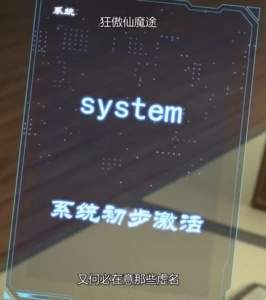
A genre often closely related to transmigration fiction is System Fiction. System fiction is a sub-Genre in which a video-game like Operation System guides the protagonist. In SVSSS this system acts like a video game hub, giving Shen Qingqiu quests, information, and counting “satisfaction” points for the protagonist. System fiction often goes hand in hand with romance, as fulfilling goals is directly reflected with rewards and success.
However, despite system fiction’s god-like operating system, it is underpinned with fears of a postmodern society. The system that can be giving and rewarding, also can remove your rewards as soon as you gain them (Feng, System 208). The system is not always benevolent, in fact it can be downright malicious, controlling the protagonist. Even worse, it can be as cold and distant as the society it embodies.
It an entity – reflecting the desires of the reader and author, for escapism, a fear of control and modern disconnect.
in SVSSS
Within SVSSS the system takes on the role of an author and also the reader, and Shen Qingqiu is both a reader and a character. The interactions between, the system, transmigration and the danmei genre create a subversive narrative that deconstructs male power fantasy novels, changing the “villain” on a meta-textual level into the protagonist of a romance drama. The work also confronts the inherent disconnect postmodern life inflicts on us, by allowing its formerly isolated protagonist to learn how to make human connection through its romance plot.
The system affirms the connections between readers and fan-culture and the story. The system acts as a fan – and rewards Shen Qingqiu for “fan-service”, improving the plot or completing side stories. It reflects and rewards the desires of the reader. Furthermore, it marks the evolution of the story, in the beginning the system is that of the male dominated Qidian site, but as Shen Qingqiu travels through the story, and changes it, his story becomes that of a “drama danmei” with the system literally changing to reflect the front page of Jinjiang (MXTX, SVSSS B3). This not only acknowledges on a meta-textual level how PIDW has been changed by the actions of the “reader” but also the differences in female vs male dominated works.
3 Subversion of Power Fantasies
SVSSS deconstructs the male power fantasy tropes. The original PIDW was a near-comical male power fantasy. The original Shen Qingqiu, because of the genre, was a sexual threat to the protagonist, and thusly had to be removed. However in the alternate Scum-Villian version, we find that our Shen Qingqiu instead decides to take a more feminine motherly role, therein removing himself as a threat, and positioning himself as a romantic partner (Ni 170). By doing this, in part because of his desire to survive the story, he changes the genre. The threat of the violent father is removed, but importantly it is by feminine labor, and not violence. By changing the villain into a nonthreatening love interest Shen Qingqiu reshapes the world. There are no more domination arcs, or bloody revenge against him, and the struggle of the protagonist changes from one of accumulating power, to a romantic struggle. The harem and xiuxen genre changes, the growth is no longer about Luo Binghe’s strength but his romantic perusal of Shen Qingqiu, thus focusing on the emotional growth of the characters, rather than their strength or fighting prowess.
These important changes being brought around by Shen Qingqiu’s recreation of feminine reproductive labor (raising Luo Binghe) directly challenges male-oriented thought process. It centers the importance and impact of often unacknowledged female labor in the creation of web-culture. Without the digital labor of women, web-fiction and online spaces would not exist in the form we know today, and SVSSS represents how this process builds and strengthens these spaces. Shen Qingqiu’s transformation of PIDW mirrors the transformative work of women in online communities, and exemplifies the shallowness of male-centric narratives.
Understanding the Failure to Reach Broader Audiences
Scum Villain Self-Saving System’s international stumbling block begins with its deep immersion in Chinese web-fiction conventions. The novel leans heavily on a built-in “System” that awards and deducts “B-Points,” footnotes, glossaries of terminology and genre tropes, and real-time authorial asides—devices that domestic Jinjiang readers instantly recognize but leave international audiences puzzled when stripped of their original context. Without familiarity with serialized publishing, “chapter-by-chapter” commentary, and the shared lexicon of xianxia/BL circles, much of SVSSS’s wit and structure simply doesn’t translate.
Unfortunately for those seeking to reach wider audiences, SVSSS is foremost a satirical deconstruction of common BL and cultivation clichés. It riffs on the generic overpowered leads, harem tropes, and fan-service by consciously spotlighting their absurdities. Luo Binghe, playing the role of overpowered protagonist, quite literally has a harem of 600 women and becomes the demon king. In the context of webnovels, this is clearly mocking the overpowered main character who begins weak and then grows to be powerful enough to kill god while attracting any woman he possibly desires. Outside the web-novel milieu and among those unfamiliar with it’s common tropes, this clear satire is more likely to feel obnoxious. Studios can’t package the story as a traditional romance or epic fantasy, and instead have to accept the element
In addition, the relationship at the core of SVSSS is significantly darker and more controversial than in MXTX’s other works. The master–disciple bond between Shen Qingqiu, a not uncommon trope in webfiction, is unpalatable to the average viewer. Luo Binghe includes non-consensual beatings, psychological gaslighting via nightmare “system” quests, and an unreliable narrator whose early actions verge on abuse. Later into the novel, we get explicit depictions of sexual assault that could unsettle viewers and put off larger publishers. While moral ambiguity exists in works like Grandmaster of Demonic Cultivation, the love in that narrative is more traditionally difficult, unlike SVSSS’s deliberate emphasis on these problematic dynamics that make broad appeal significantly less likely.
To fully appreciate this book, one must understand the Chinese webfiction ecosystem, the common cliches of cultivation novels, and be comfortable with a relationship that is much less careful about consent. The explicit nature of the text combined with just how steeped in online culture the text is makes it unapproachable for the general audience that would need to embrace it in order to make it widely popular.
Digital Labor and Fan-Communities
Scum Villain is by no means unsuccessful, however it is the least successful of MXTX three works. On Jinjiang it has a fourth of the points TGCF enjoys, and out of the three series MXTX has written, it has the least adaptations. SVSSS boasts a cancelled manhua (followed by an unofficial one), a 3D donghua, which was also cancelled in season one, as well as print versions in multiple. These reflect a failure to reach audiences beyond readership. Despite this it thrives in a very specific group of fans, who have been able to deeply connect with this work.
Like its official adaptations, Scum Villain enjoys the smallest fandom. However, they are the most dedicated. Upon observation, while SVSSS fandom does not have breadth of other fan communities, its fans are the most dedicated and “old-school”. Its fans engage in older forms fandom behavior – such as multi-shipping (shipping characters with more than one character), creative play, and theory creation. They are more open to differing opinions, and engage with riskier content (SA, Pro-Shipping and other more controversial aspects of fandom). This is indicative of older fandoms, where the activities were focused more on playing with the story and exploring different scenarios than adherence to specific requirements.
They also have less “fan wars” and engage more with “don’t like, don’t read” mentality. Wherein if one does not like an aspect of a work or opinion, you simply do not engage. This may be affected by the type of work SVSSS inherently is. Out of all of her novels, SVSSS is the most controversial of MXTX’s works, as it has instances of sexual assault and is the most meta-textually embedded in fan-community. This may have fostered a type of selection bias, as those drawn to SVSSS in general are people who already have a certain mentality regarding the nature of web-literature. It may be less accessible than other series, but those who understand it are more likely to accept all aspects of transformative works.
In regards to digital labor, the SVSSS, represents, like its protagonist, the concept of the “digital housewife”. Wherein, female fans, and in story, Shen Qingqiu, do often unpaid, and underappreciated feminine labor that provides support to the backbone of online fan communities. This is represented in story- where Shen Qingqiu’s feminine, motherly, work, literally causes the story to change genre – showing how feminine labor creates webficiton.
The creation of fandom, and its most creative aspects, such as transformative works (including fanfiction, cosplay and events), is often due to the labor of female fans, and goes unrecognized. This mirrors the very SVSSS fandom itself, where it is built of extremely dedicated fans, yet is still under-represented in comparison to MXTX’s other works. The SVSSS fandom is a creative hub, and calls back to the days of smaller, more dedicated fan spaces, yet is the least popular or acknowledged, mirroring the labor of digital housewives in the production of fanculture.
- These laws make it a criminal offense to earn above a certain amount of money, proving that SVSSS was commercially a success. ↩︎
- This fact is incredibly hard to prove for a few different reasons. Firstly, while we do know that MXTX did go to jail, she is a largely anonymous author, so there is no confirmation this is in fact what she was jailed for and is a popular theory. ↩︎